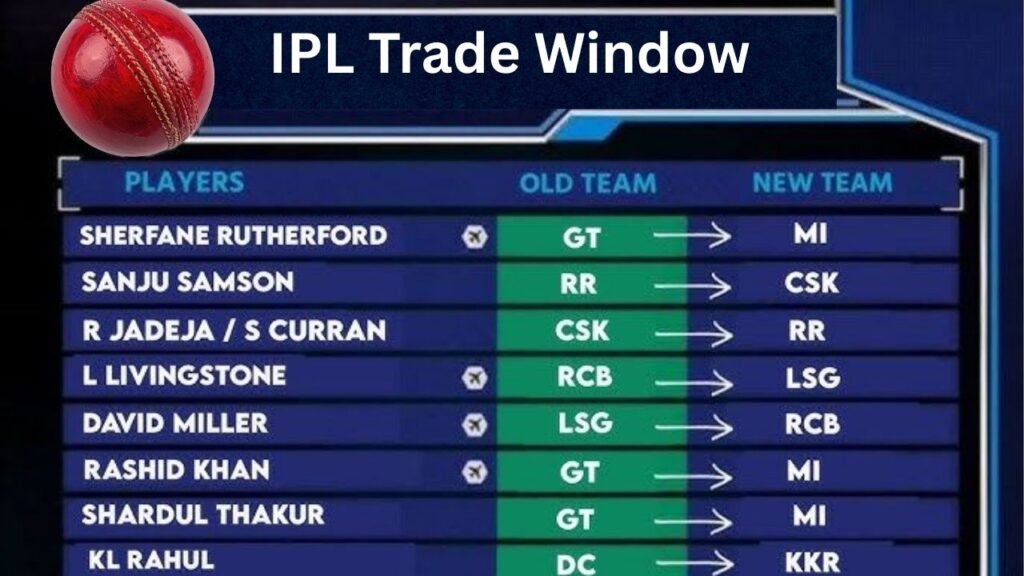
The IPL trade window is definitely one of the most exciting and strategic phases in Indian Premier League history. Although fans often concentrate on auctions and matches, the IPL trade window is quietly reshaping team combinations in the background. It is a designated period in which franchises can trade players among themselves. This can be done either through direct swaps or cash deals well before the start of next season. It’s during the IPL trade window that rules of employment are relaxed. The most ruthless players can be released by a team, which can bring in more players in an attempt to balance their squad within the salary cap regulations. The IPL trade window has, over the years, become an indispensable tactical tool— should not any franchise wait for the mega auction to rebuild, rebrand or fine-tune their playing XI. It comes off the road.
The IPL trade window doesn’t just move players around. From surprise player transfers to strategic captaincy moves, the IPL trade window adds a further layer of drama and competition, making it an integral element of the league’s ecosystem in itself.
How does the IPL Trade Window Work? Understanding Standard Operating Procedure
In order to understand the IPL trade window, one must be clear about the structure of it and various rules which govern the transaction. The official schedule of the trade window is also often set by the Board of Control for Cricket in India (BCCI).
It is usually after the end of a season that the IPL holds its trade window, and keeps it open until certain deadlines before next season’s auction or tournament commencement. There are generally two stages:
- Post-season window : Opens shortly after the IPL final.
- Pre-auction window : Closes a few days before the mini or mega auction.
Rules of the IPL Trade Window :
- A player can only be transferred if the permission of all three parties is obtained: the selling franchise, the receiving one and the player.
- The salary of the transferred player is included in the purse for the new team.
- Trades can be player-for-player exchanges either in the form of players or cash deals.
Unlike auctions, where fierce bidding wars determine a player’s value–the IPL trade window is much more laid-back and cordial; negotiation style. Before any deal can be finalized, teams have to weigh up performance data, injury history, team balance and future plans.
Different trades allowed in IPL trade window
There are two kinds of trades accepted during the IPL window. Each type of trade fulfils certain strategic objectives for the team as a whole and its make-up fundamentally.
Trade one player for another
This way, two teams can exchange players directly. It is best if both have surplus in certain positions and lack depth elsewhere. A team strong in fast bowling but weak at middle-order batting may swap accordingly.
Pure cash deal
By this method, one franchise acquires a player and then absorbs his salary in to your own kitty without sending players the other way for compensation. The buying team is actually itself paying out.
Multiple player trade
While not very common, in a single operation more than one protagonist can be involved at the same time. Their squad is also weighted heavily
The trade window serves this dual function: it is not only an example of the strategic manoeuvrings clubs carry out ahead of their encounters but also lays out future plans for coaching and players alike. It’s about understanding market conditions, something which cannot be achieved in an auction so much as a section of a bazaar known as an unfit.
The Difference Between IPL Trade Window and IPL Auction
Many fans are confused about the difference between an IPL trade window and an IPL auction. Both affect team composition, but their ways and means are different.
| Aspect | IPL Trade Window | IPL Auction |
| Timing | Before auction/season | Pre-season event |
| Format | Direct negotiation | Open bidding |
| Player Availability | Contracted players only | Registered players pool |
| Strategy Level | Targeted trading | Competitive bidding |
| Media Coverage | Low-key | High-profile event |
The IPL trade window is quieter but often more strategic. Auctions create headlines, but trade windows quietly decide long-term team balance.
Why IPL Trade Window Is Important for Franchises
Squad Balance
The significance of the IPL trade window is also It has a direct impact on team strategy.
Financial Planning
A team may discover weaknesses in a particular season. The IPL trade window provides room for instant correction before the next campaign begins.
Leadership Adjustments
IPL Salary capping management is very important. By getting rid of high-priced not up to standards players, teams can loosen the purse strings.
Sometimes franchises trade experienced players in order to strengthen leadership groups or even bring in new captains. The IPL trade window provides the kind of flexibility that auctions alone cannot offer.
Impact of the IPL Trade Window on Team Performance
Across the years, some teams have been able to change their fortunes through clever trading. Well-timed moves during the IPL trade window will help to:
- Strengthen the core squad
- Provide a wealth of experience for young line-ups
- Go beyond the capabilities of main lineup members
- Employ greater role clarity
Teams that use the IPL trade window to full advantage will usually find themselves more prepared and balanced when they go to play. On the other hand, passive teams may suffer at auction time if their actual on-field requirements do not align with what has been discussed beforehand.
The trade window spares franchises from having to continue into the future with contracts that they inherited in less profitable times.
What Teams Think About in the IPL Trade Window from a Strategic Point of View
Today, during the IPL trade season, franchises are murmuring on data analytics. Football clubs like Chelsea once built their teams solely based on feelings and intuitions about who would perform well–but decisions rarely are emotional nowadays and most of them are made following the dictate of data.
Statistics on Performance
Teams look at such things as strike rates, economy rates, pressure-tight bowling and match impact statistics.
Records of fitness or injury
A long-term injury may send a team searching for someone more dependable in terms of health.
The Conditions and How the Team Looks
The home ground is very important. Spin-friendly conditions may tempt teams trading for good spinners to play matches there more often than otherwise.
The IPL trade window won’t be a simple player exchange but rather a high-level strategic boardroom decision.
IPL Trade Window’s Challenges and Limitations
A beneficial situation, the IPL trade window nonetheless has its drawbacks. Player consent is a must. If a player refuses to be relocated, then a trade will not happen. Second, there are constraints on salary caps which limit flexibility. Third, not all franchises are prepared to release key players-therefore discussions can get complicated.
In addition, bad management of the trade window can upset team chemistry. The IPL trade window should require effective programing and good communication. Should no one be mindful, these sudden changes could easily affect the club’s dynamics.
How Does The IPL Trade Window Function In The Mega Auction Cycle
The IPL trade window becomes even more crucial in mega auction years. As a team you need to decide which core players should stay with you and which should be let loose to the auction pool.
In such times the trading splash is often quite high-profile with teams looking to alter their image. From old squads to new starts this then makes the IPL trade window an ark.
Compared with normal years, such mega auction seasons have very different rhythms and the trading activity in general is much more lively.
Brand New Trading System Shows the Fastest Way to Riches!
Still, this system is less publicized than auctions. But the IPL trading window can make its impact felt through online media. Fans will speculate, compute the potential profits of one player or team for another’s, and argue over where any transfer should go next.
From tomorrow, cricket analysts will start going in for lively discussions of each transfer and what it implies. Change often takes only a single move during the IPL trading window to reverberate dramatically on title predictions made months earlier.
With digital channels accelerating reports of each rumor, the trade window has now been transformed from off-season sideshow into one of the major talking points for cricket’s yearly calendar.
The future of the IPL Trade Window
As franchise cricket continues to make inroads globally, something like the IPL trade window will be emulated by other leagues in due course. Structured trading systems promote competitiveness and prevent long-term stagnation.
What else may we see in the future?
- Longer trading periods
- More transparent trade notices
- Digital records of all trades
The IPL trade window will grow in importance as the players’ financial stakes and an increasingly competitive atmosphere increasingly demonstrates their abilities.
Conclusion: Why the IPL Trade Window Is a Game-Changer
The IPL trade window is not just another transfer period. It constitutes a strategic mechanism that helps to build team spirit and performances. Although auctions receive the headlines, IPL trade window quietly determines lasting success.
From talent levels and financial management to changes in leadership style and tactics, the IPL trade window is a crucial part of team planning. Teams that can successfully negotiate these steps often win before the first ball of a season is bowled.
In today’s IPL, ignoring the IPL trade window is not an option. It is a major cornerstone of a shrewd and durable team management.
FAQS :
1. When does the IPL Trade Window open and close?
The IPL Trade Window usually opens after a season ends and closes before the next auction or tournament begins. The names of the exact dates are announced by the league organizer and will be published on its site shortly later this month
2. How is the IPL Trade Window different from the IPL Auction?
The biggest difference between the IPL Trade Window and the IPL Player Auction is that the Ipl Trade Window is a normal market, which lasts for a time but does not have all of the contract commitments included in it. The market player is not bound to simply go to any franchise that makes an offer. It is like one of those non-televised manipulations in a video game: a direct deal between two teams, exchanging players without any public bidding.
3. Can a player refuse to be traded during the IPL Trade Window?
After the Transfer Window closes, there is one month. Players who were bought by their current teams in the Trade Window can reject transfer.
4. Does the IPL Trade Window affect a team’s salary cap?
Yes, any trade made during the IPL Trade Window will affect the salary purse of a franchise–and not necessarily in a good way. The buying franchise must fit the player’s salary within its budget limit. Since there are a lot of Chinese players in the IPL, will graft and
Read also : Most Expensive IPL Team | Fastest Delivery in IPL History